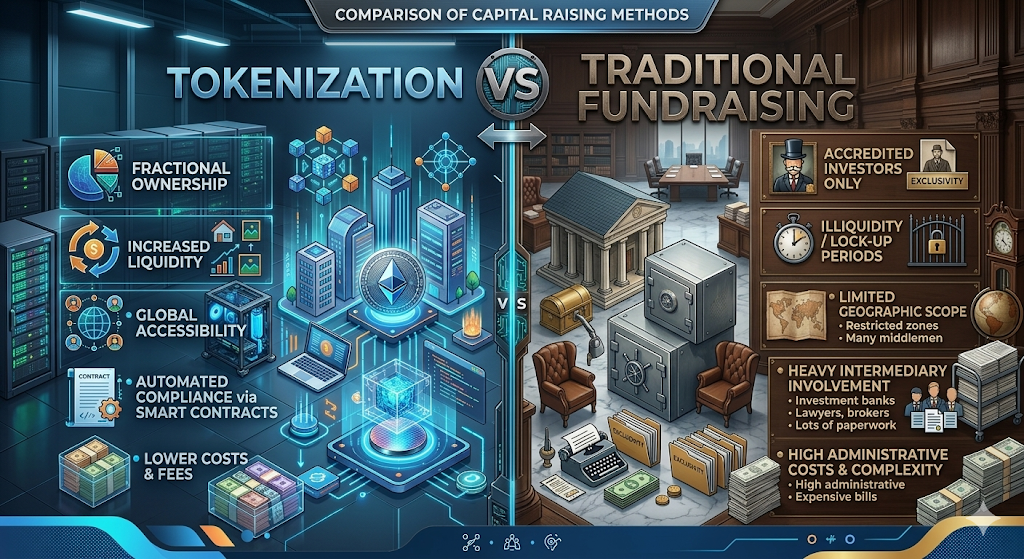
Fundraising has long been the backbone of business growth, enabling startups and enterprises to secure capital for expansion. Traditionally, methods like venture capital, bank loans, and public offerings have dominated this space. However, with the rise of blockchain technology, Tokenization vs Traditional Fundraising has become a critical discussion for modern businesses. Tokenization introduces a more accessible, transparent, and efficient way to raise funds, reshaping how assets are financed and traded.
Understanding Traditional Fundraising
Traditional fundraising relies on centralized systems and intermediaries. Businesses typically raise capital through:
- Venture capital and private equity
- Bank loans and financial institutions
- Initial Public Offerings (IPOs)
While these methods are well-established, they come with several challenges. High entry barriers, regulatory complexities, and long processing times often limit access—especially for small and medium-sized enterprises. Additionally, investors are usually restricted by geography and accreditation requirements, which reduces the overall pool of potential participants.
What is Asset Tokenization?
Asset tokenization refers to the process of converting real-world assets—such as real estate, equities, commodities, or art—into digital tokens on a blockchain. These tokens represent fractional ownership of the underlying asset, allowing investors to buy, sell, or trade them easily.
By leveraging blockchain, asset tokenization ensures:
- Enhanced transparency
- Improved liquidity
- Fractional ownership opportunities
- Reduced dependency on intermediaries
Businesses often collaborate with an asset tokenization development company to create secure and compliant tokenized platforms tailored to their fundraising needs.
Key Differences: Tokenization vs Traditional Fundraising
1. Accessibility and Inclusivity
Traditional fundraising is often limited to accredited investors and institutional players. In contrast, tokenization democratizes investment by enabling global participation. Anyone with internet access can invest in tokenized assets, significantly expanding the investor base.
2. Liquidity
One of the major drawbacks of traditional fundraising is illiquidity. Investments like real estate or private equity can take years to exit. Asset tokenization solves this by enabling secondary market trading, allowing investors to buy and sell tokens with ease.
3. Cost Efficiency
Traditional fundraising involves multiple intermediaries such as brokers, legal advisors, and banks, leading to higher costs. Tokenization reduces these expenses by automating processes through smart contracts, making fundraising more cost-effective.
4. Transparency and Security
Blockchain technology ensures that all transactions are recorded on a decentralized ledger, providing unmatched transparency. In traditional systems, lack of transparency can lead to fraud or mismanagement. Tokenization enhances trust among investors through immutable records.
5. Speed of Transactions
Traditional fundraising processes can take weeks or even months due to regulatory approvals and manual procedures. Tokenized fundraising significantly reduces this timeline by automating issuance and compliance through blockchain-based systems.
Benefits of Asset Tokenization for Fundraising
Businesses are increasingly adopting asset tokenization for its numerous advantages:
- Fractional Ownership: Investors can own smaller portions of high-value assets.
- Global Reach: Access to international investors without geographical limitations.
- Improved Liquidity: Easier entry and exit for investors.
- Automation: Smart contracts streamline operations and reduce manual errors.
An experienced asset tokenization development company can help businesses design and deploy platforms that ensure regulatory compliance while maximizing these benefits.
Challenges to Consider
Despite its advantages, tokenization is not without challenges:
- Regulatory uncertainty in different jurisdictions
- Lack of standardization across platforms
- Limited awareness among traditional investors
However, as governments and regulatory bodies continue to establish clearer frameworks, these challenges are gradually being addressed.
The Future of Fundraising
The debate around Tokenization vs Traditional Fundraising is not about replacing one entirely but rather about evolution. Tokenization is set to complement traditional methods by offering a more flexible, inclusive, and efficient alternative.
As blockchain adoption grows, more businesses are turning to asset tokenization to unlock new funding opportunities. Partnering with a reliable asset tokenization development company ensures that organizations can navigate technical and regulatory complexities while building scalable fundraising solutions.
Conclusion
Tokenization is transforming the fundraising landscape by breaking down traditional barriers and introducing innovative financial models. While traditional fundraising methods remain relevant, asset tokenization offers a forward-looking approach that aligns with the digital economy. Businesses that embrace this shift early will gain a competitive edge, accessing a broader investor base and unlocking new avenues for growth.
 Site Title